
Please note that the full access to this content needs a subscription: please sign up.
Traditional French Christmas
This recipe is a protected and only available for paid members. To obtain the full step by step recipe and detailed ingredients list, please sign up.
Preview the recipe
Where To Find Your Capon
- Capon chicken for sale (aka: rooster meat), can be found through some specialized online retailers. For those who are lucky enough to live in the Tarn region, order your poultry at the Maleterre farm, Le Maraudeur in St Antonin-Noble-Val. The Mille family raises their capons following this ancestral tradition.


Pro Tip
- 1. Meat too cold while popped in the oven: Cooking time will have to be pushed forward, increasing the risk of drying out.2. Skipping checking the internal temperature: A probe digital thermometer is your kitchen's best friend for perfect cooking. 3. Resting time too short: Poultry should rest for 30 minutes before carving. Even longer for larger birds.
Roasting Method
- This method applies to all poultry, including a Thanksgiving turkey. A typical turkey for this purpose should weigh between 3.5 and 4 kg (approximately 8 pounds). The stuffing can be prepared a day in advance. Truss the bird and season it generously with salt and pepper, both inside and out.Place the bird in a large roasting pan. Add the mirepoix, the chopped neck, and 2 cups (500g) of the chicken stock that was used to cook the chestnuts. Leave prepared bird out for 3 hours at least before cooking; it will cook faster.

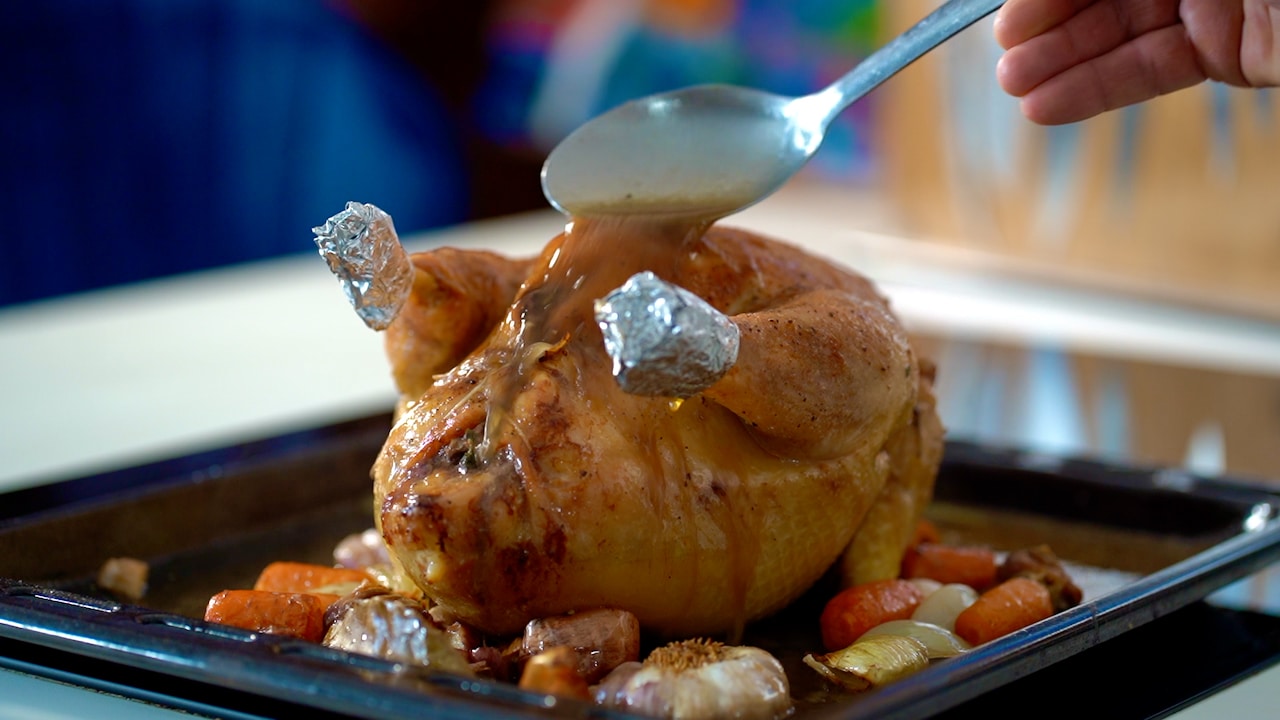
- Preheat your fan oven to 330ºF/165ºC. Roast the bird for approximately 2 hours and 30 minutes, basting it occasionally. To check for doneness, insert a meat thermometer into the thickest part of the breast. The capon is safely cooked when the internal temperature reaches 160ºF (70ºC).Once removed from the oven, let the bird rest for at least 30 minutes. During this time, the internal temperature will continue to rise slightly (carryover cooking), and the juices will redistribute throughout the meat, resulting in a more tender and flavorful result.To keep the skin crisp, do not cover the bird with foil during resting.This traditional roasting method is a reliable classic. Furthermore, the juices left in the pan will make an excellent base for your sauce or gravy.


Poaching Cooking Method
- Place the bird into a large Dutch oven and pour in enough cold chicken stock to come halfway up the sides. Cover the pot with a large piece of parchment paper, pressing it down so the edges touch the liquid around the sides. This creates a sealed environment.Slowly bring the liquid to a boil, then reduce the heat and let it simmer gently for 90 minutes. Occasionally baste the top of the parchment paper. This technique helps steam and moisturize the breast from both above and below.After poaching, carefully remove the bird from the pot and let it drain on a baking tray fitted with a cooling rack. Be sure to reserve the flavorful cooking liquid for gravy or sauce. Preheat fan oven 350ºF/180ºC.

- Transfer the poached capon onto a baking tray lined with a cooling rack to drain for 5 minutes. Transfer the bird onto a baking tray or roasting pan and bake 50 minutes. Let rest 30 minutes before carving.


Cleaning Out The Capon
- Unwrap the bird (do not wash), and place it onto a large and stable cutting board (use rubber bands or a few wet paper towels to stabilize it). Reach into the posterior of your capon to remove the giblets. Tip of the wings may also be chopped off. Save the neck and liver for the recipe. The heart and gizzards can be saved for later use. Season the inside of the bird with salt and pepper generously. Wash your hands often with soap or wear gloves to avoid the spread of salmonella. Clean cutting board with soap and hot water. Then, spray bleach to sanitize it – let sit for an hour or two; rinse with cold water, let dry and put away.


The Stuffing
- This stuffing can be used to make regular terrine (pâté). In this case, do not add croutons. The ingredients for the stuffing can be prepared ahead of time, and kept in separate containers. Stuffing cooked inside the bird cavities is delicious, but it does slow down the cooking time and could be a potential health hazard if done incorrectly. For perfect no-worry results, opt for stuffing cooked in terrine. A stuffed bird should be cooked within 24 hours.
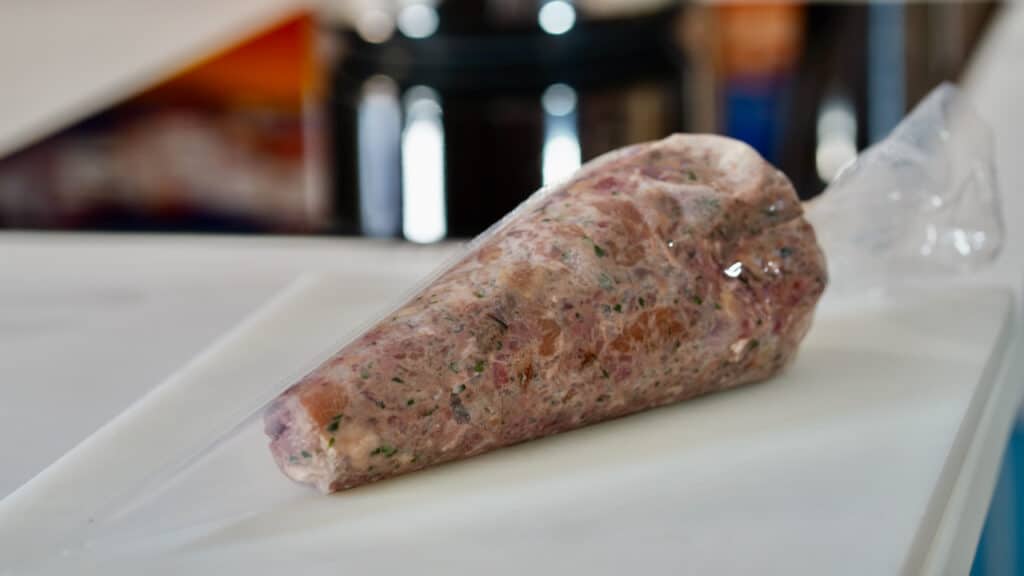
- Cook terrine in a bain-marie 45 minutes until internal temperature reaches 167ºF/75ºC.


Croutons
- You can use any type of bread, such as pain de mie, to make croutons. Cut the bread into even, bite-sized cubes and place them in a large bowl. Drizzle the cubes with olive oil, melted duck fat, or melted butter. Toss to coat evenly. Season with herbes de Provence, salt, and pepper. You can also add garlic or onion powder at this stage. Toast the bread cubes in a skillet over medium heat on the stovetop, or spread them on a baking sheet and toast in the oven. Cook, stirring occasionally, until they are golden brown and crisp.Let the croutons cool completely. Once cooled, store them in an airtight container or a freezer bag at room temperature for up to two weeks.


Stuffing
- This stuffing should be prepared a maximum of one day in advance. Soak the bread in milk and set it aside.Cook the Chestnuts: Place the chestnuts in a pot and cover them with cold chicken stock or water. Bring to a boil and simmer for about 25 minutes, or until fork-tender. Drain the chestnuts, reserving the stock for the roasting bird. Refrigerate the cooked chestnuts until ready to use.In a large frying pan, cook the smoked bacon over medium heat until it renders its fat. Add the shallots, onions, garlic, and herbs, and cook until softened and fragrant. Add the chopped liver to the pan and sauté briefly until it is no longer raw on the outside. Pour in the port to deglaze the pan, scraping up any browned bits. Transfer the entire mixture to a tray or bowl and refrigerate until completely cold. In a large bowl, combine the cold ground meats, the chilled bread (squeezed of excess milk), the cooled shallot-liver mixture, the cooked chestnuts, and all remaining ingredients and seasonings.Wearing disposable gloves, mix everything together gently until just combined. Do not over mix. Keep the stuffing refrigerated for no more than 24 hours. For food safety and to check seasoning, cook a small spoonful of the stuffing in a skillet or the oven until fully cooked, then taste it and adjust the seasoning of the main batch if needed.


How To Truss a Capon
- Trussing a chapon/capon or any other bird ensures that the legs and wings are firmly attached against the body. This helps the chicken maintain its shape and cook evenly. There are a few ways to truss a chicken. The technique using an ≈8-inch/20cm trussing needle tough, happens to be more reliable.


Step 1
- Pierce the center of one wing, and go all the way through and under the spine to reach out to the opposite wing.


Step 2
- Flip the capon breast side up.


Step 3
- Do likewise going through the thickest part of both legs.
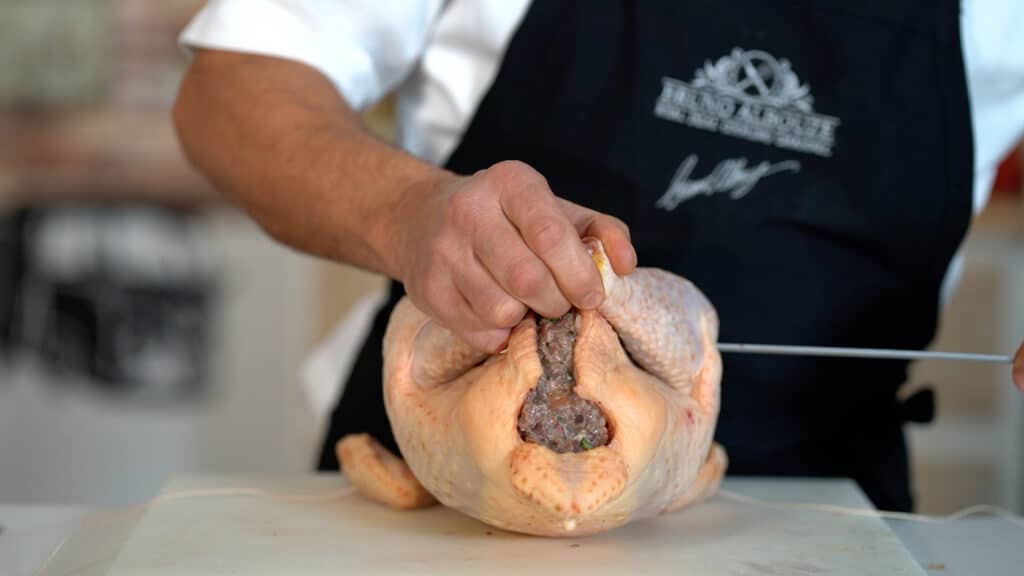

Step 4
- Lay the bird on its side and tight up. Cut bucher twine and make a double knot.
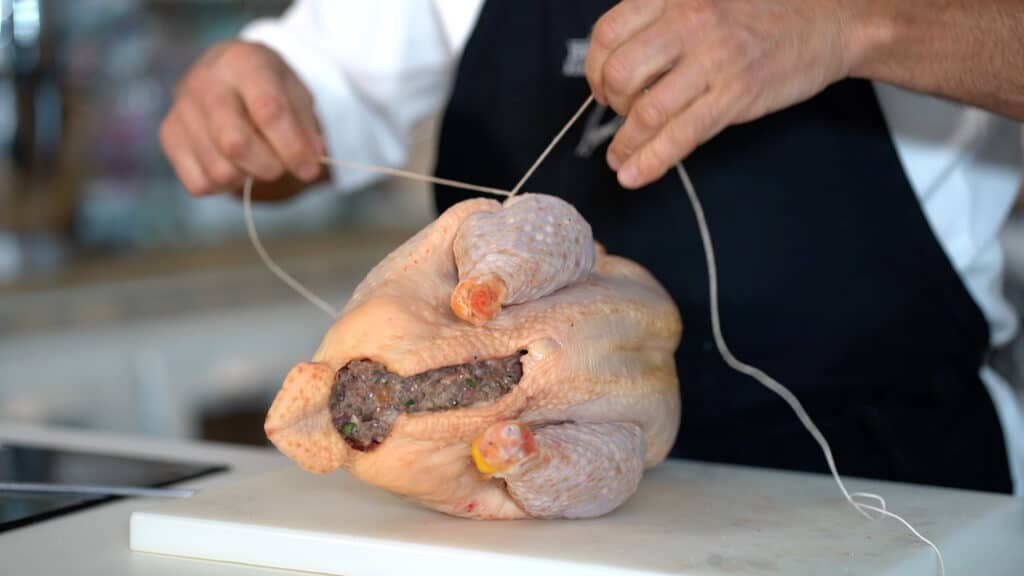

Step 5
- Lastly, seal the stuffed cavity by pushing the rump inwards – make a double knot. Refrigerate prepared capon for up to 12 hours. Season capon with salt and pepper, and cook according to your preference as described above.


Butternut-Potato Gratin
- Place prepared butternut and peeled potatoes in a saucepan. Cover with water and cook for about 30 minutes until fork tender. Drain well and pass through a food meal or use a potato masher. Put mixture back to the pan and heat up adding butter gradually. Add grated parmigiano and then the mascarpone. Season with salt and pepper to taste. Fill casserole dish, top with more parmigiano and bake at 435ºF/225ºC for 10 minutes until golden brown.


Sautéed Porcini Mushrooms
- In a very hot pan, add duck fat and sautée porcini on high heat until golden brown. Add shallots, salt and pepper and continue to cook for 5 minutes. Deglaze with a dash of white wine. Add parsley and croutons if desired. Keep mushrooms warm on a tray and in the oven. Transfer mushrooms to a casserole dish or arrange around the capon right before serving.


Sauce
- If you have chosen to roast the capon, use the resting time to prepare a sauce from the pan drippings. Remove the roasted onions, carrots, and garlic from the roasting pan and set them aside for garnishing the final dish.Make the Jus: Place the roasting pan on the stovetop over medium heat. Scrape the browned bits from the bottom of the pan. Add chicken stock and bring to a boil, scraping continuously to dissolve all the flavorful bits into the liquid. Strain the liquid into a saucepan to remove any solid pieces. Bring it to a simmer and cook for about 20 minutes, allowing it to reduce slightly. Frequently skim off the fat that rises to the surface (this fat can be saved for other uses, like roasting potatoes).Finish the Sauce: Add a dash of port if desired, and season with salt and pepper to taste. Just before serving, whisk in cold butter until the sauce is glossy and slightly thickened. Ensure the sauce does not boil after adding the butter.


Gravy
- If you have chosen to poach the capon, use the resulting stock to make a gravy. Strain the stock through a fine-mesh sieve into a saucepan. Bring it to a simmer and let it reduce by about half, or until the flavor is well-concentrated.In a small separate bowl, make a slurry by whisking together 30g (about 2½ tablespoons) of cornstarch with 2 tablespoons (40g) of cold stock or water until completely smooth. While the reduced stock is at a steady boil, gradually whisk in the slurry. Continue to cook for a minute or two, whisking constantly, until the gravy thickens to your desired consistency. Season with salt and pepper to taste.


Glazed Chestnuts
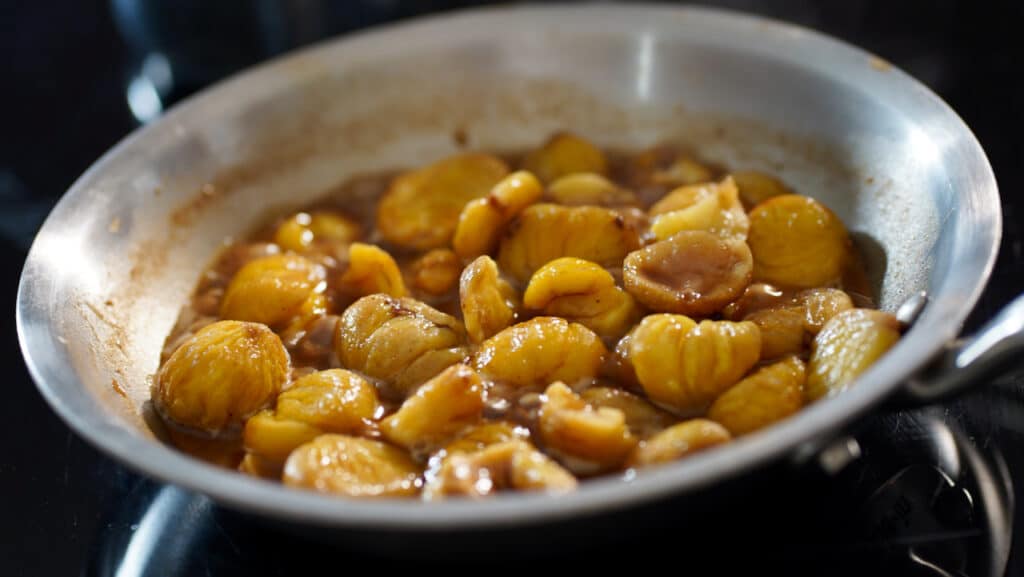
- In a skillet, reheat cooked chestnuts with a chunk of butter, and a splash of the finished sauce or gravy. Season with salt and pepper to taste.

Carving Capon
- Remove bucher twine. Make a cut around the left thigh open up, it should pop and cut through the join. Do likewise with the other leg. Separate drumsticks from the thighs. Furthermore, deboning drumsticks and thighs are an option.


Carving Step 2
- Slice the breast into serving portions from the bone by sliding the knife between the meat and the bone. Note that it is good practice to remove the wishbone before or after cooking.


Carving Step 3
- Cut off both wings from the join.


Carving Step 4
- With shears, cut through the carcasse to liberate the stuffing. Flip the carcasse and remove the sot-l'y-laisse (chicken oyster) located above the rump. After carving, collect all the goodness left on the cutting board and add it to the finished sauce/gravy. Save carcasse for your next OMG chicken stock!..
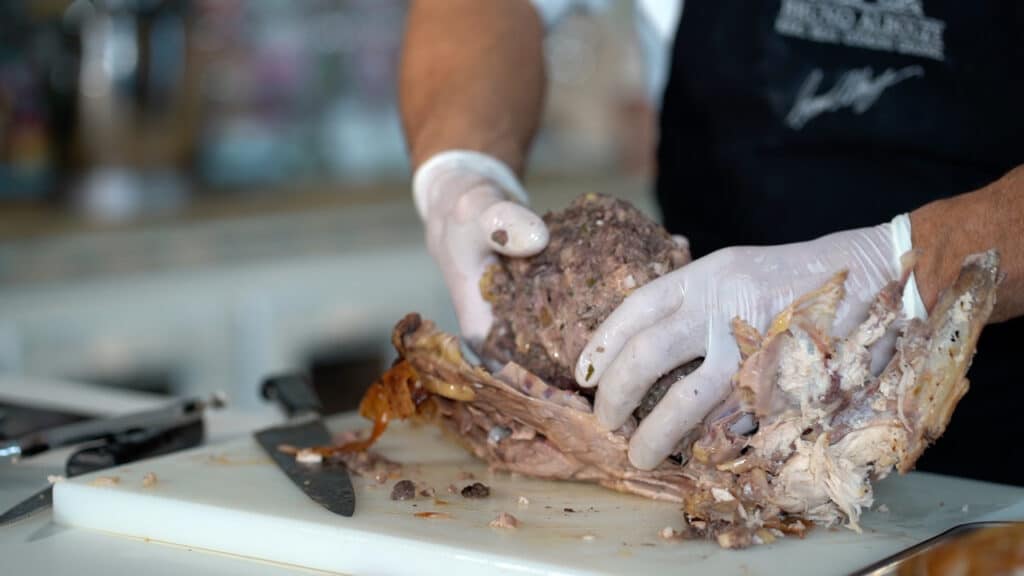
- For the final presentation, simply reconstitute the bird starting with the stuffing. Serve with the glazed marrons, cèpes and the gratin.
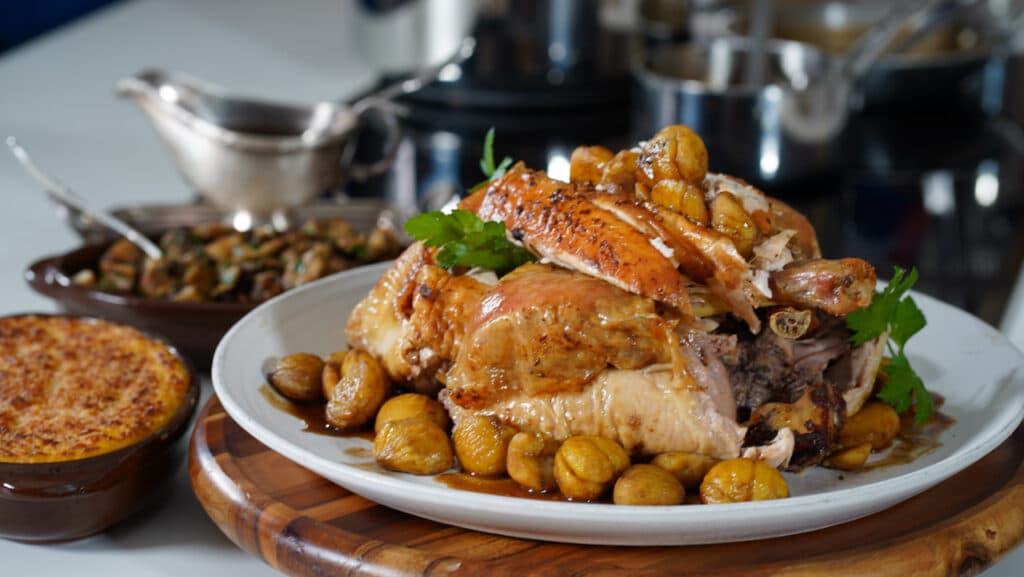


Plating Capon
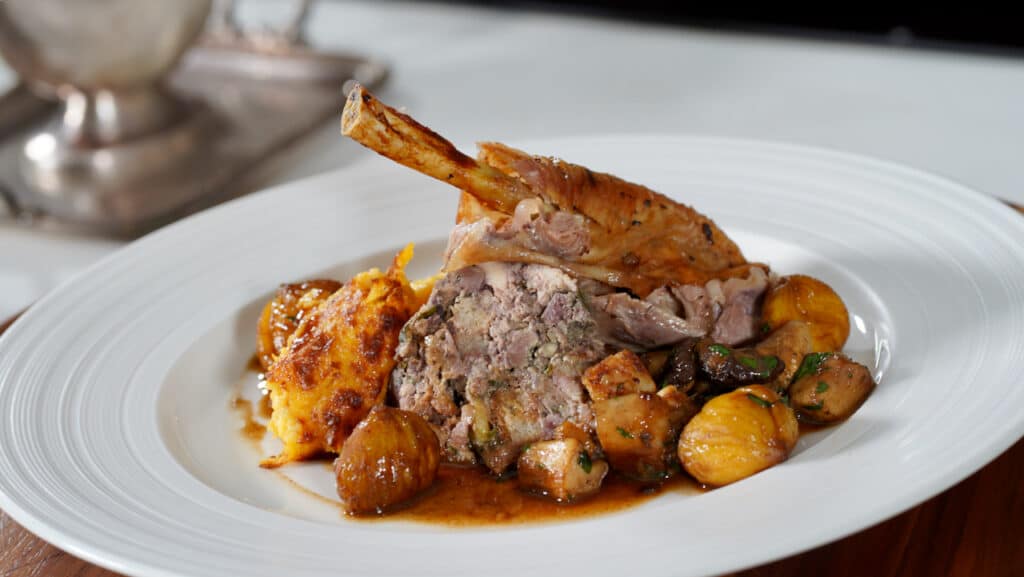
- On a hot plate, spoon out butternut-potato gratin first, followed by a piece of the stuffing, meat, mushrooms, glazed chestnuts and the sauce. Merry Christmas!

Ready to discover this recipe? You're only 1 step away.
This recipe is only accessible to registered members!
Create your account to access all recipes and content of my website.
Join us now and enjoy more 800 recipes (Mostly French with European Influences, American Classics and Asian fusion)
Already register? Sign in


Appetizers
Beetroot Red Cabbage Mango Salad

Free Recipes
How To Prepare Red Cabbage Raw


Free Recipes
Apple Pie Traybake

Cakes
Olive Oil Chocolate Cake

Desserts
Spicy Chocolate Bar

Entrees
Deboning A Poularde Leg
Free Recipes
Chanterelle

Bread
Panettone Perdu

Free Recipes
Mustard Fig Spread

Free Recipes
Poularde Demi-Glace
