
Please note that the full access to this content needs a subscription: please sign up.
Once of the best treat ever made
This recipe is a protected and only available for paid members. To obtain the full step by step recipe and detailed ingredients list, please sign up.
Preview the recipe
Origins and Types of Nougat Explained
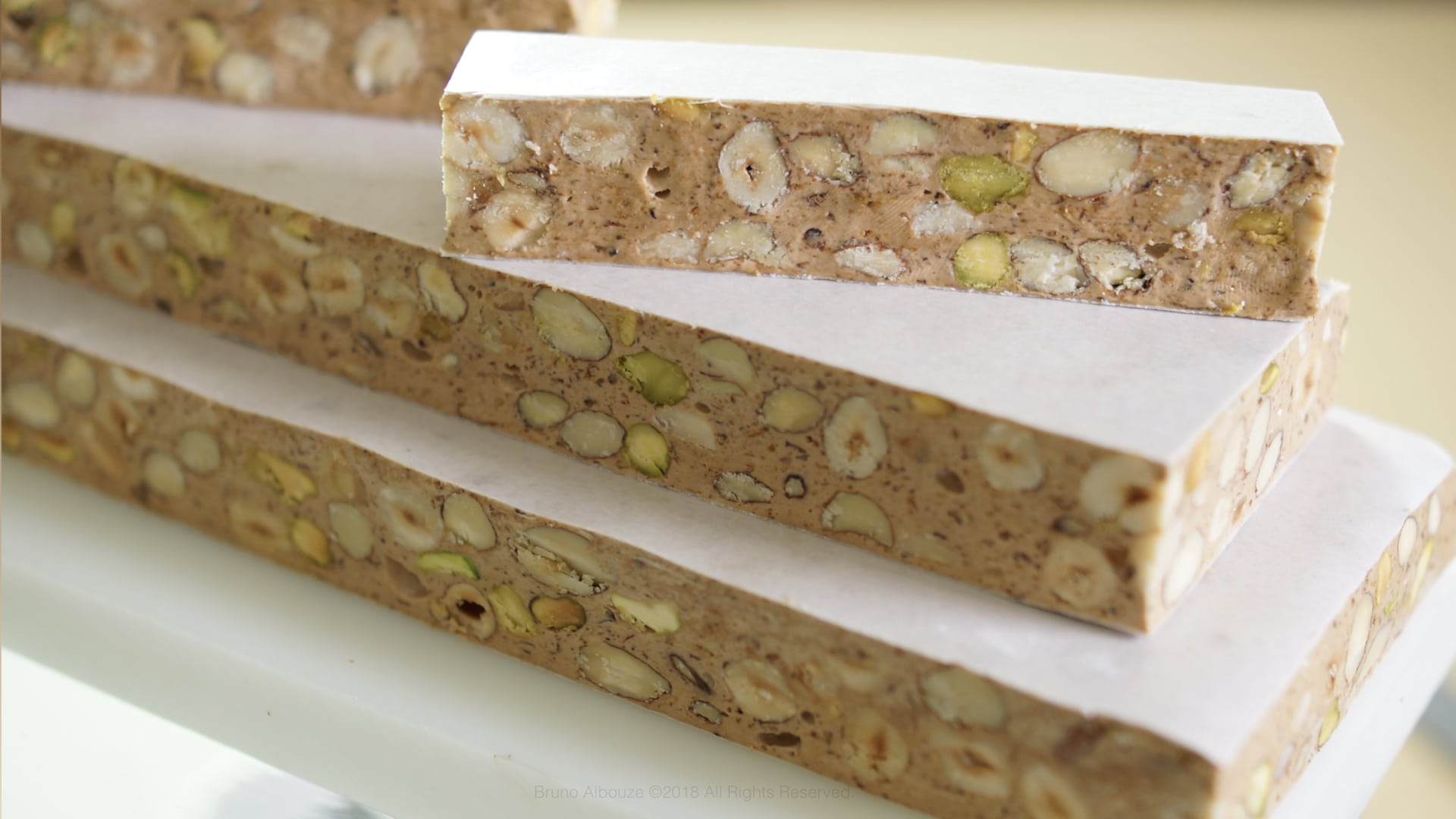
- Many legends exist about nougat’s origins. The word “nougat” derives from the Latin “nux gatum,” meaning “nut cake” (gâteau aux noix). It spread to Western Europe from the Byzantine Empire during the era of the Roman Empire.There are three basic kinds of nougat. The first and most popular is white nougat—called mandorlato or torrone in Italy and turrón in Spain. It is made from beaten egg whites and a cooked syrup of honey and sugar. White nougat appeared in Italy in the early 15th century, in Alicante, Spain in the 16th century, and later in Marseille and Montélimar, France, in the 18th century.The texture of nougat can range from soft to hard; the higher the temperature of the cooked sugar syrup, the harder the resulting nougat. Nougat can also be finished in the oven to achieve a toasted color and a firmer texture. The recipe below yields a medium-firm consistency.Nougat de Montélimar must contain at least 30% dried fruits, such as almonds and pistachios. (Note that nougat paste is different and requires only 15%.) The quality of nougat depends significantly on the percentage and quality of both dried fruits and honey. Candied orange peel elevates nougat to another level (as in nougat de Montélimar à l’orange). Other dried fruits—such as apricots, cherries, or raisins—can be added, along with flavors like lemon, anise, vanilla, ginger, or chocolate. Nougat is an important component of Christmas celebrations in many cultures.
Meringue For The Nougat
- Before you begin, prepare a baking tray or mold. Lightly oil the sides. Line the bottom with one of the following: a sheet of wafer paper (glossy side down), a dusting of the sifted sugar-starch mixture, or a thin layer of finely crushed nuts. Note: Do not use plastic wrap in direct contact with the hot nougat, as it will melt and become difficult to remove.Have the measured ingredients for the sugar syrup and honey syrup ready in two separate saucepans. Begin cooking the sugar syrup first. Meanwhile, in the bowl of a stand mixer fitted with the whisk attachment, beat the room-temperature egg whites and cream of tartar on medium-low speed. Maintain the egg whites at a foamy stage, just before soft peaks form.When the sugar syrup reaches 220°F (120°C)—this should take approximately 15 minutes—reduce its heat to low. Immediately begin cooking the honey syrup over high heat. Once the honey reaches 266°F (130°C), the meringue should still be foamy or just reaching soft peaks. Increase the mixer speed to high. With the mixer running, pour the hot honey in a thin stream down the side of the bowl. Continue beating on high.By this time, the sugar syrup should have reached 293°F (145°C), the firm-ball stage. With the mixer still running on high, carefully pour the hot sugar syrup into the meringue in a steady stream. This step is crucial for aerating the nougat and creating its fluffy, chewy texture. Once all the syrup is incorporated, reduce the speed to medium-high and continue beating for 5 full minutes.Turn off the mixer and swap the whisk attachment for the paddle. Add the hot cocoa butter and warm gianduja. Turn the mixer back on to low speed and mix for about one minute until fully combined. Add the warm nuts and mix on low for just a few seconds until incorporated. Do not overmix, or the nuts will break into pieces.Lightly oil a spatula and your fingertips. Working quickly, transfer the sticky, warm-hot nougat mixture into the prepared pan. Shape it into a rectangle. Top with a second sheet of wafer paper (glossy side up) and use a rolling pin to smooth and compress the surface evenly. Let the nougat cool at room temperature for several hours, or chill to set completely.If the nougat has been chilled, let it sit at room temperature for about 30 minutes to soften slightly before cutting. It should be firm but not rock-hard.
Tip For Cooking Sugar Syrup & Honey
- If the required temperature of the sugar is ready too soon, reduce the heat and lower down its temperature by dropping a couple of teaspoons of cool water into the hot syrup – stay in control until it goes back up to the right temp.
Nougat Assembly
- Wafer Paper (Papier Azime) – 0.3mm thickness wafer paper is ideal for shaping nougat and aids in long-term storage. It can be sourced from most cake decorating suppliers.Alternatively, you can use the prepared sugar-starch mixture to prevent sticking, or coat the base with finely ground pistachio meal, hazelnuts, desiccated coconut, or similar ingredients. To unmold the nougat, first run an oiled spatula around all the edges, then gently flip the slab onto a clean work surface. Using a sharp serrated knife, trim the uneven edges. Next, cut the slab in half lengthwise. Then, slice each half crosswise into 11 individual bars. Lightly dust the knife with the sugar-starch mixture between cuts to prevent sticking.
Wrapping and Storage
- Individual bars can be wrapped in wax paper or cellophane. For a professional finish, they can also be enrobed tempered chocolate. Like most confections, nougat stores best for several months in a cool, dry environment, ideally between 57–61°F (14–16°C). For home storage—particularly in warm climates or during the summer—the refrigerator is a suitable option. If refrigerated, allow the nougat to rest at room temperature for about 30 minutes, or until it softens slightly, before serving.
Cleaning Utensils
- To clean the utensils used for making nougat, soak the mixing bowl and other equipment in hot, soapy water. Once the mixture has softened and cooled, wash and rinse the items thoroughly. Alternatively, they can be cleaned in a dishwasher; however, the knife should always be washed by hand.
Ready to discover this recipe? You're only 1 step away.
This recipe is only accessible to registered members!
Create your account to access all recipes and content of my website.
Join us now and enjoy more 800 recipes (Mostly French with European Influences, American Classics and Asian fusion)
Already register? Sign in


Appetizers
Beetroot Red Cabbage Mango Salad

Free Recipes
How To Prepare Red Cabbage Raw


Free Recipes
Apple Pie Traybake

Cakes
Olive Oil Chocolate Cake

Desserts
Spicy Chocolate Bar

Entrees
Deboning A Poularde Leg
Free Recipes
Chanterelle

Bread
Panettone Perdu

Free Recipes
Mustard Fig Spread

Free Recipes
Poularde Demi-Glace
